Stakeholder Engagement for ESRS Reporting
/ Engage Meaningfully. Strengthen Materiality. Report with Credibility.
Course Description
Meaningful stakeholder engagement is central to credible sustainability reporting, supports due diligence and informs materiality assessment under the European Sustainability Reporting Standards (ESRS). This live, instructor-led course helps participants understand who to engage, how to prioritise stakeholders, how to design effective engagement strategies and how stakeholder interests and views are reflected in ESRS reporting. Through guided discussions, an applied engagement model and organisational case studies, participants learn to connect stakeholder input with strategy, material impacts, risks and opportunities, and the relevant ESRS disclosure requirements.
 English or Bosnian/Croatian/Serbian
Live Online
Face-to-Face
Tailored
Learning Outcomes
By the end of the course, participants will be able to:
explain the importance of engaging with stakeholders for sustainability reporting, including for the materiality assessment;
define the key components of an effective stakeholder engagement strategy;
describe the reporting requirements of the ESRS related to stakeholder engagement; and
apply lessons learned from case studies to support successful stakeholder engagement.
Course
Structure
The workshop combines licensed GRI content with presentations, guided discussions, reflection activities, knowledge checks, an applied stakeholder engagement model and organisational case studies, helping participants connect meaningful engagement with materiality, strategy and ESRS reporting.
Introduction
- Welcome, orientation and learning objectives
- The role of stakeholder engagement in ESRS reporting
- Key sources and concepts used throughout the course
- Affected stakeholders and users of sustainability statements
Part 1:
Relevance of Stakeholder Engagement for Sustainability Reporting
- Why stakeholder engagement matters for transparency, accountability and reporting credibility
- The role of affected stakeholders and users of sustainability statements
- Stakeholder engagement as a core element of due diligence
- How stakeholder input informs the materiality assessment
- Identifying and prioritising stakeholders according to specific activities and impacts
- Considering silent stakeholders, stakeholder representatives and proxy organisations
- The relationship between stakeholder engagement, strategy, risk management and value creation
Part 2:
Effective Stakeholder Engagement Strategies
- The characteristics of meaningful stakeholder engagement:
- two-way communication;
- responsiveness;
- good-faith participation; and
- ongoing engagement
- Integrating stakeholder engagement throughout the sustainability reporting process
- The Stakeholder Value Network and its connection with organisational value creation
- The stakeholder engagement model:
- why the organisation is engaging;
- what matters are being addressed;
- who should participate; and
- how the engagement will be conducted
- Benchmarking and gap analysis of existing engagement practices
- Identifying and prioritising stakeholder groups
- Designing an engagement plan
- Conducting and evaluating engagement activities
- Ongoing and project-specific engagement approaches
- Direct and indirect engagement methods
- Managing common challenges, including competing interests, resource constraints, communication breakdowns and reluctance to share information
Part 3:
ESRS Reporting Requirements Related to Stakeholder Engagement
- The structure of the ESRS and the role of Disclosure and Application Requirements
- Why the ESRS do not prescribe a single stakeholder engagement method
- Engagement with affected stakeholders as part of due diligence
- The role of stakeholder dialogue in impact materiality assessment
- ESRS 2 SBM-2 — Interests and views of stakeholders
- ESRS 2 IRO-1 — Process to identify and assess material impacts, risks and opportunities
- How stakeholder interests and views inform strategy and the business model
- How consultation with affected stakeholders can inform the materiality assessment
- Stakeholder-related requirements in the social Topical Standards, where applicable and subject to materiality:
- ESRS S1 — Own workforce
- ESRS S2 — Workers in the value chain
- ESRS S3 — Affected communities
- ESRS S4 — Consumers and end-users
- Reporting channels, grievance mechanisms and approaches to remedy, where applicable
Part 4:
In Practice — Case Studies on Effective Stakeholder Engagement
- Organisational examples of structured stakeholder engagement
- Approaches to engaging different stakeholder groups
- Integrating stakeholder perspectives into governance and decision-making
- Collecting, categorising and responding to stakeholder feedback
- Connecting engagement outcomes with strategy, reporting and materiality
- Lessons from successful practices and implementation challenges
- Identifying approaches that participants can adapt to their own organisations
Wrap-Up
- Summary of key concepts
- Final knowledge check
- Reflection, Q&A and next steps
Together, the course progresses from understanding why stakeholder engagement matters to designing meaningful engagement, interpreting ESRS reporting requirements and applying lessons from organisational practice.
Important Clarification
The Stakeholder Value Network, AA1000 Stakeholder Engagement Standard and stakeholder engagement model are used as supporting guidance and practical reference points. They are not requirements of the ESRS.
Who
Should Attend
This course is particularly suitable for:
sustainability and ESG professionals involved in ESRS reporting;
reporting practitioners preparing sustainability disclosures;
professionals responsible for stakeholder engagement and materiality assessment;
consultants and professional advisers supporting ESRS reporting;
communications, compliance, strategy and stakeholder-relations professionals; and
managers responsible for sustainability due diligence or engagement processes.
The course is suitable both for beginners and for experienced professionals seeking to strengthen their stakeholder engagement practices in the ESRS context.
Course
Information
Duration:
One-day live workshop
Language:
English or
Bosnian / Croatian / Serbian
Delivery Options:
Scheduled Live Online, Face-to-Face at the University of Sarajevo, or tailored in-house delivery worldwide
Prerequisites:
No specific prior knowledge is required
Recommended Preparation:
Participants are encouraged to download and review the current ESRS before attending the course
Course Materials:
Applicable licensed course materials and a dedicated participant booklet
Certificate:
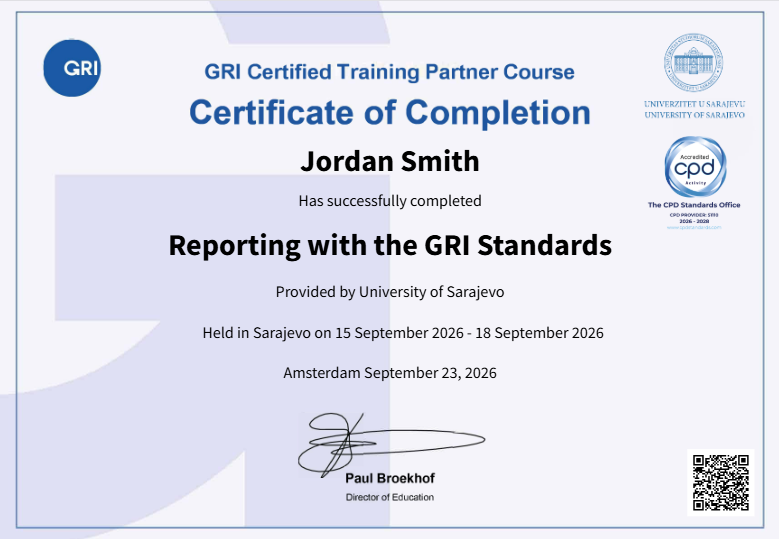
Digital GRI Certificate of Completion, available after completing the course and the required GRI feedback survey
️Approved CPD Hours:
5 CPD Hours
Professional Certification Pathway:
This course is one of six required courses within the GRI Certified ESRS Sustainability Professional pathway
Course Content Updates:
Course content is reviewed before each cohort to reflect key CSRD and ESRS regulatory and standard-setting developments
Group & In-House Options

10% discount for groups of five or more participants from the same institution

Custom pricing for larger groups, institutional programmes and donor-funded initiatives

Tailored in-house training is available worldwide and quoted separately based on group size, location and logistics
Meet the
ESRS Training Team
Ready to Turn Stakeholder Input into Better ESRS Reporting?
Build the practical understanding needed to engage stakeholders meaningfully, strengthen materiality decisions and support credible ESRS disclosures.
 Follow Us