How to Collect and Report Material Information under the ESRS
/ Collect Reliable Data. Structure Material Disclosures. Report with Confidence.
Course Description
Collecting and reporting material information under the European Sustainability Reporting Standards (ESRS) can be complex, with numerous Disclosure Requirements and datapoints to manage. This live, instructor-led course provides practical guidance on common data collection activities, the ESRS 2 General Disclosures, and reporting on material sustainability matters through topical and entity-specific disclosures. Through guided walkthroughs, practical examples and the Prysmian case study, participants learn how to collect reliable qualitative and quantitative information, structure relevant disclosures, strengthen internal controls and assurance readiness, and understand when information required by the ESRS may be omitted.
 English or Bosnian/Croatian/Serbian
Live Online
Face-to-Face
Tailored
Learning Outcomes
By the end of the course, participants will be able to:
list common data collection activities for sustainability reporting;
identify the general Disclosure Requirements under the ESRS;
identify the ESRS requirements for reporting on material matters;
define Disclosure Requirements and datapoints from the ESRS, including those that derive from other EU legislation, for different material matters; and
explain how information required to be reported under the ESRS can be omitted.
Course
Structure
The workshop combines licensed GRI content with guided walkthroughs, practical examples, knowledge checks and an organisational case study, helping participants connect reliable data collection with ESRS Disclosure Requirements and material sustainability matters.
Introduction
- Learning objectives and key ESRS reporting concepts
- The relationship between double materiality, data collection and reporting
Part 1:
Common Data Collection Activities
- Quantitative and qualitative sustainability information
- Data collection methods, responsibilities and cross-functional collaboration
- Value chain information and data-gap assessment
- Internal controls, documentation and assurance readiness
- Digital tools supporting sustainability data management
Part 2:
Reporting on ESRS 2 General Disclosures
- Basis for Preparation
- Governance
- Strategy and Business Model
- Impact, Risk and Opportunity Management
- Metrics and Targets
- Minimum Disclosure Requirements for policies, actions, metrics and targets
- Datapoints derived from other EU legislation and relevant phase-in provisions
Part 3:
Reporting on Material Sustainability Matters
- Translating double materiality results into reporting content
- Identifying relevant topical Disclosure Requirements and datapoints
- Connecting material matters with policies, actions, metrics and targets
- Preparing entity-specific disclosures where necessary
- Understanding permitted omissions and phase-in provisions
- Reporting the absence of policies, actions, metrics or targets where required
Part 4:
Reporting on ESRS E1, S2 and G1
- ESRS E1 — Climate Change
- ESRS S2 — Workers in the Value Chain
- ESRS G1 — Business Conduct
- Selecting material Disclosure Requirements and datapoints
- Applying the corresponding Application Requirements
- Applying the Standards through practical reporting examples
Part 5:
In Practice — Prysmian Case Study
- Preparing for a first ESRS sustainability statement
- Governance, responsibilities and cross-functional collaboration
- Reviewing available information and addressing data gaps
- Strengthening internal controls, documentation and assurance readiness
- Practical lessons for first-time ESRS reporters
Wrap-Up
- Summary of key concepts
- Final knowledge check
- Reflection, Q&A and next steps
Together, the course progresses from collecting reliable sustainability information to structuring ESRS 2 disclosures, reporting on material sustainability matters, applying selected topical Standards and drawing practical lessons from organisational experience.
Who
Should Attend
This course is particularly suitable for:
sustainability and ESG professionals coordinating ESRS reporting;
corporate reporting teams preparing for a first ESRS reporting cycle;
data owners, analysts, controllers, finance professionals and system owners managing sustainability information;
data owners, analysts, controllers, finance professionals and system owners managing sustainability information;
consultants and professional advisers supporting ESRS implementation;
internal auditors and assurance professionals reviewing reported information and supporting evidence; and
risk, compliance, operations, procurement and value chain teams contributing to sustainability data collection.
No previous knowledge of the GRI Standards is required.
Course
Information
Duration:
One-day live workshop
Language:
English or
Bosnian / Croatian / Serbian
Delivery Options:
Scheduled Live Online, Face-to-Face at the University of Sarajevo, or tailored in-house delivery worldwide
Prerequisites:
No specific prior knowledge is required
Recommended Preparation:
Participants are encouraged to download and review the current ESRS before attending the course
Course Materials:
Applicable licensed course materials and a dedicated participant booklet
Certificate:
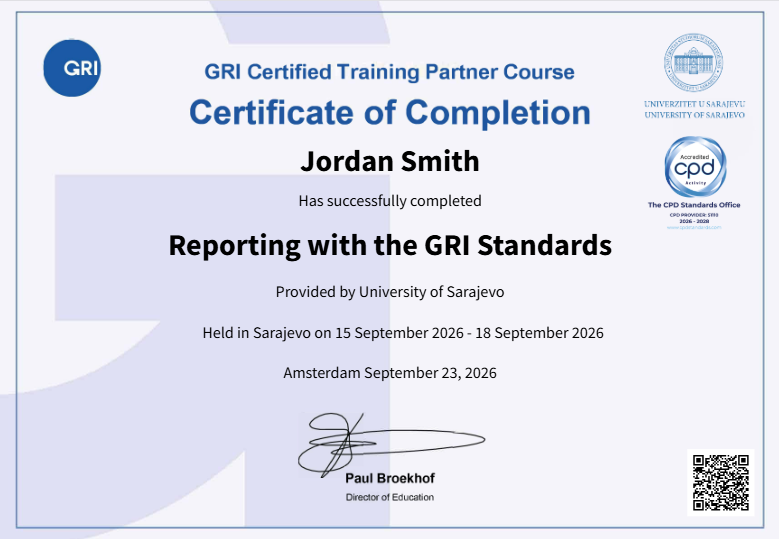
Digital GRI Certificate of Completion, available after completing the course and the required GRI feedback survey
️Approved CPD Hours:
5 CPD Hours
Professional Certification Pathway:
This course is one of six required courses within the GRI Certified ESRS Sustainability Professional pathway
Course Content Updates:
Course content is reviewed before each cohort to reflect key CSRD and ESRS regulatory and standard-setting developments
Group & In-House Options

10% discount for groups of five or more participants from the same institution

Custom pricing for larger groups, institutional programmes and donor-funded initiatives

Tailored in-house training is available worldwide and quoted separately based on group size, location and logistics
Meet the
ESRS Training Team
Ready to Turn Materiality into Reportable Information?
Build the practical understanding needed to collect reliable data, structure relevant disclosures and report material sustainability matters with clarity.
 Follow Us