External Assurance for Sustainability Reporting: A Comprehensive Guide
/ Understand Assurance. Strengthen Reporting Systems. Choose the Right Provider.
Course Description
As sustainability reporting becomes increasingly widespread, stakeholders expect reported information to be credible, reliable and subject to independent assurance. This live, instructor-led course provides a comprehensive introduction to third-party assurance of sustainability reporting, covering its purpose and benefits, key terminology and standards, limited and reasonable assurance, organisational preparation, the assurance engagement process and the selection of an appropriate assurance provider. Through guided discussions, practical examples and applied scenarios, participants learn how to assess reporting systems and internal controls, define their assurance needs, prepare effectively for an engagement and work more confidently with external assurance professionals.
 English or Bosnian/Croatian/Serbian
Live Online
Face-to-Face
Tailored
Learning Outcomes
By the end of the course, participants will be able to:
describe the benefits, challenges and process of third-party sustainability reporting assurance, including the related costs and timing;
state the different standards used for sustainability assurance, the differences between them and the organisations that use them;
explain key assurance terms to improve communication between assurance and sustainability professionals within their organisation;
describe the elements of a good reporting system and use them to prepare for external assurance;
explain the key aspects to consider when appointing an external assurance provider; and
match their organisation’s assurance needs with the expertise and capabilities of potential assurance providers.
Course
Structure
The workshop combines licensed GRI content with guided discussions, practical examples, reflection activities and knowledge checks, helping participants understand sustainability assurance, prepare their reporting systems and select an assurance provider suited to their organisation’s needs.
Introduction
- Learning objectives and key assurance concepts
- The role of independent assurance in credible sustainability reporting
Part 1:
The “What” and “Why” of External Sustainability Reporting Assurance
- The purpose, value and principal drivers of external assurance
- Voluntary and mandatory assurance
- Core elements and terminology of an assurance engagement
- Limited and reasonable assurance
- Commonly used sustainability assurance standards
- Differences between sustainability assurance and financial auditing
Part 2:
Preparing Your Organisation for External Assurance
- Governance, responsibilities and reporting criteria
- Data collection, consolidation and documentation
- Internal controls and traceability
- Assurance-readiness and gap assessments
- Timing, resources and cost considerations
Part 3:
Understanding the Assurance Process
- Defining the assurance scope and level
- Planning the engagement
- Collecting and testing evidence
- Evaluating findings and revising reported information
- Finalising and issuing the Independent Assurance Report
- Common pitfalls and opportunities for improving reporting systems
Part 4:
Finding the Right Assurance Provider
- Types of sustainability assurance providers
- Provider-selection criteria, including independence, competence, standards, quality, cost and organisational fit
- Defining the scope, timelines and expectations
- Preparing an invitation to tender and evaluating proposals
- Working effectively with the selected assurance provider
Applied scenarios are integrated throughout the course to illustrate assurance-readiness gaps, evidence and documentation challenges, cost and timing implications, and provider-selection decisions.
Wrap-Up
- Summary of key concepts
- Final knowledge check
- Reflection, Q&A and practical next steps
Together, the course progresses from understanding sustainability assurance principles and terminology to preparing reporting systems, navigating the engagement process and selecting an assurance provider aligned with organisational needs.
Who
Should Attend
This course is particularly suitable for:
sustainability and ESG reporting professionals new to external assurance;
managers responsible for corporate reporting and public disclosures;
finance, accounting and internal audit professionals, as well as financial auditors working with sustainability information;
data owners and professionals responsible for reporting systems and internal controls;
governance, legal, risk and procurement professionals involved in assurance engagements;
consultants and professional advisers supporting sustainability reporting and assurance readiness; and
professionals responsible for selecting or working with an external assurance provider.
The course is suitable both for participants with little or no previous third-party assurance experience and for audit professionals seeking to understand the specific challenges of assuring sustainability information.
Course
Information
Duration:
Two-day live workshop
Language:
English or
Bosnian / Croatian / Serbian
Delivery Options:
Scheduled Live Online, Face-to-Face at the University of Sarajevo, or tailored in-house delivery worldwide
Prerequisites:
No specific prior knowledge is required
Course Materials:
Applicable licensed course materials and a dedicated participant booklet
Certificate:
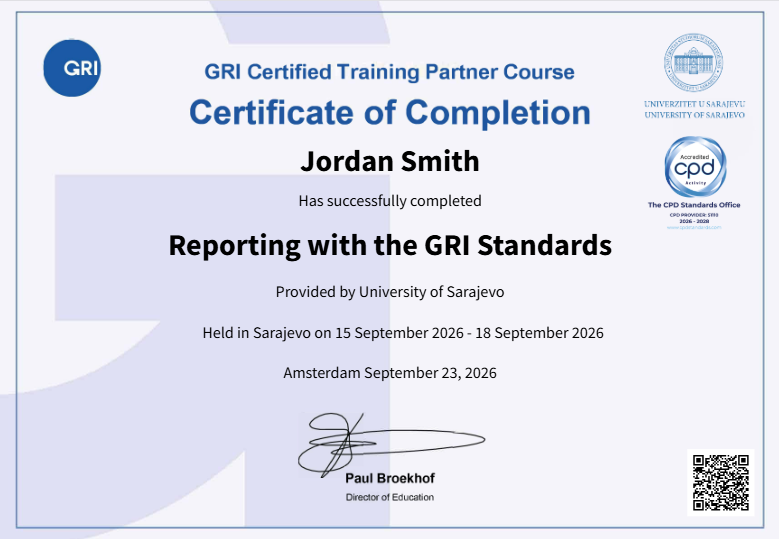
Digital GRI Certificate of Completion, available after completing the course and the required GRI feedback survey
️Approved CPD Hours:
5 CPD Hours
Course Type:
Standalone specialist course; not required for either professional certification pathway
Course Content Updates:
Course content is reviewed before each cohort to reflect relevant developments in sustainability assurance standards and practice
Group & In-House Options

10% discount for groups of five or more participants from the same institution

Custom pricing for larger groups, institutional programmes and donor-funded initiatives

Tailored in-house training is available worldwide and quoted separately based on group size, location and logistics
Meet the
GRI Training Team
Ready to Strengthen the Credibility of Your Sustainability Reporting?
Build the knowledge needed to prepare your reporting systems, navigate the assurance process and select an assurance provider aligned with your organisation’s needs.
 Follow Us