Completing the Picture: Climate Reporting with GRI and IFRS Standards
/ Connect Impact and Financial Perspectives. Report Climate with Confidence.
Course Description
Climate reporting is moving beyond greenhouse gas emissions to encompass transition and adaptation planning, climate resilience, just transition, and the interconnected impacts, risks and opportunities affecting organisations, people and nature. This live, instructor-led course focuses on two complementary global instruments—GRI 102: Climate Change 2025, which supports reporting on an organisation’s climate-related impacts, and IFRS S2 Climate-related Disclosures, which focuses on climate-related risks and opportunities relevant to investors. Through guided discussions, practical examples and the Ørsted case study, participants learn how the Standards differ, where they align and how they can be used together to support comprehensive, credible and decision-useful climate reporting.
 English or Bosnian/Croatian/Serbian
Live Online
Face-to-Face
Tailored
Learning Outcomes
By the end of the course, participants will be able to:
reflect on the importance of climate reporting and the role it plays in addressing climate change;
describe the shift towards a more holistic climate-reporting approach that includes human and biodiversity dimensions;
explain key components of climate reporting, including greenhouse gas emissions, transition plans and adaptation strategies;
explain why reporting only on climate-related risks is insufficient;
explain how the GRI Standards and IFRS Sustainability Disclosure Standards complement each other in providing a comprehensive climate-reporting framework; and
identify common challenges in climate reporting and explore best practices.
Course
Structure
The workshop combines licensed GRI content with guided discussions, practical examples, reflection activities, knowledge checks and an organisational case study, helping participants connect climate-related impacts, risks and opportunities with comprehensive reporting under GRI 102 and IFRS S2.
Introduction
- Learning objectives and key climate-reporting concepts
- Climate-related impacts, risks and opportunities
- The relationship between climate action, transparency and accountability
Part 1:
Why Climate Reporting Matters
- Climate change as a business, environmental and societal challenge
- Growing expectations for credible climate transparency
- The shift from emissions-focused to comprehensive climate reporting
- Impact materiality, financial materiality and the role of double materiality
- GRI 102 and IFRS S2 as two complementary climate-reporting instruments
Part 2:
From Emissions to a Just Transition — What to Report on Climate
- Scope 1, Scope 2 and Scope 3 greenhouse gas emissions
- Value chain emissions and the role of the GHG Protocol
- Transition plans for climate-change mitigation
- Integrating transition planning into organisational strategy
- Adaptation plans, climate resilience and scenario analysis
- Just transition principles, human rights and stakeholder engagement
- Interconnections between climate change, biodiversity, nature and social impacts
Part 3:
Reporting with GRI 102 and IFRS S2
- Selecting the appropriate climate-reporting instrument
- The purpose and principal disclosures of GRI 102: Climate Change 2025
- Transition, adaptation, just transition and emissions disclosures under GRI 102
- The structure and principal requirements of IFRS S2 Climate-related Disclosures
- Governance, strategy, risk management, metrics and targets
- Climate resilience, transition planning and scenario analysis
- Common ground and key differences between the Standards
- Alignment, interoperability and using GRI 102 and IFRS S2 together
Part 4:
Practical Insights and First Steps in Climate Reporting
- Governance, responsibilities and cross-functional collaboration
- Common climate-reporting pitfalls and how to address them
- Scope 3 measurement and reporting challenges
- Developing credible transition and adaptation plans
- Strengthening transparency around just transition and human rights
- Engaging stakeholders in climate-related disclosure
- Using innovative tools and approaches to improve reporting quality
Supplementary Case Study — Ørsted
- Ørsted’s sustainability-reporting journey
- Double materiality and climate-reporting priorities
- Transition-plan actions, targets and financing
- Adaptation planning and principal implementation challenges
- Social, biodiversity and just-transition dimensions
- Practical advice, best practices and lessons for reporting organisations
Wrap-Up
- Summary of key concepts
- Final knowledge check
- Reflection, Q&A and practical next steps
Together, the course progresses from understanding why climate reporting matters to identifying what organisations should report, applying GRI 102 and IFRS S2 together and drawing practical lessons from organisational experience.
Who
Should Attend
This course is particularly suitable for:
sustainability, ESG and climate-reporting professionals;
reporting practitioners beginning or strengthening their climate-reporting journey;
finance, risk, strategy and investor-relations professionals supporting climate-related disclosure;
consultants and professional advisers working with impact, financial or double materiality;
data, governance, internal audit and assurance professionals supporting climate reporting;
professionals responding to regulatory, investor or stakeholder requests for climate-related information; and
investors, analysts, policymakers, academics and other users of climate-related information.
The course is suitable both for newcomers to climate reporting and for experienced professionals seeking to understand how GRI 102 and IFRS S2 can be applied together.
Course
Information
Duration:
One-day live workshop
Language:
English or
Bosnian / Croatian / Serbian
Delivery Options:
Scheduled Live Online, Face-to-Face at the University of Sarajevo, or tailored in-house delivery worldwide
Prerequisites:
No specific prior knowledge is required
Course Materials:
Applicable licensed course materials and a dedicated participant booklet
Certificate:
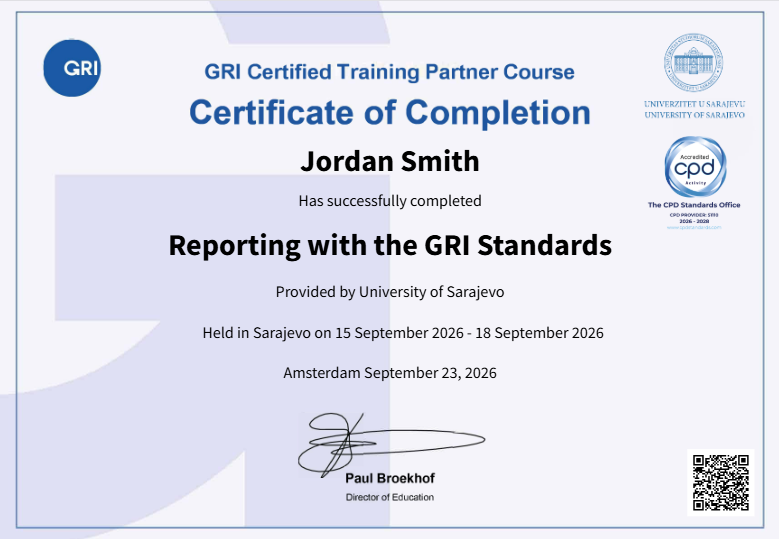
Digital GRI Certificate of Completion, available after completing the course and the required GRI feedback survey
️Approved CPD Hours:
5 CPD Hours
Course Type:
Standalone specialist course; not required for either professional certification pathway
Course Content Updates:
Course content is reviewed before each cohort to reflect relevant developments in GRI 102, IFRS S2, climate-reporting practice and related guidance
Group & In-House Options

10% discount for groups of five or more participants from the same institution

Custom pricing for larger groups, institutional programmes and donor-funded initiatives

Tailored in-house training is available worldwide and quoted separately based on group size, location and logistics
Meet the
GRI Training Team
Ready to Complete the Climate Reporting Picture?
Build the practical understanding needed to connect climate-related impacts, risks and opportunities and report comprehensively using GRI 102 and IFRS S2.
 Follow Us